
Indian Classical Dance – Some Reflections.
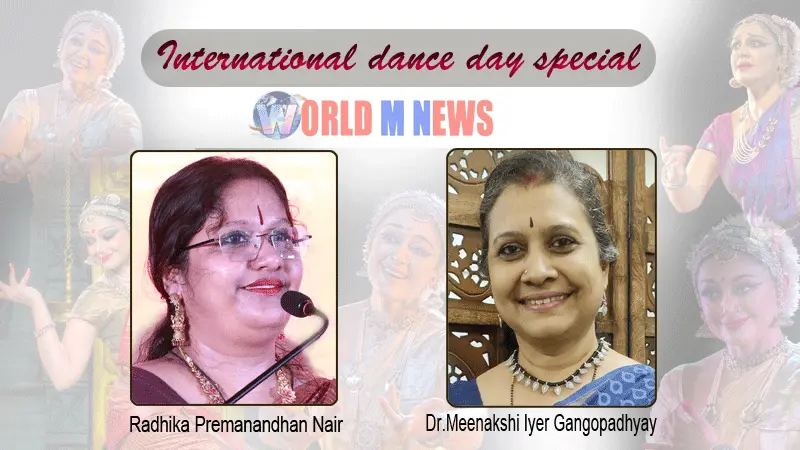
Dr. Meenakshi Iyer Gangopadhyay is a distinguished Bharata Natyam exponent, scholar, researcher, and educator, whose work spans performance, pedagogy, and academic inquiry. Trained from a very young age under the illustrious Padma Bhushan Dr. Kanak Rele, she completed her Master’s degree in Fine Arts (Dance) and earned her Ph.D. in Dance from the University of Mumbai. Her doctoral research, titled “Aesthetic Symbiosis between Vācikābhinaya and Body Kinetics in Bharata Natyam,” reflects her deep engagement with the theoretical and performative dimensions of the art form.
With an interdisciplinary academic background that includes Master’s degrees in Commerce and Indology, along with a Diploma in Sanskrit, she brings a holistic perspective to dance studies.She has been serving as a Professor at Nalanda Nritya Kala Mahavidyalaya, Mumbai, for over three decades, and currently holds key academic positions as the Head of the Department and Chairperson of the Board of Studies (Dance). She is also associated with academic bodies such as the Central Sanskrit University and the Maharaja Sayajirao University of Baroda, contributing actively to curriculum development and higher education in dance.
A recognized Ph.D. guide, she has mentored several scholars and contributed extensively to research through publications, lectures, and workshops. She has also been a dance critic for leading publications such as Sruti, Nartanam, and Narthaki.
Dr. Gangopadhyay is the recipient of prestigious honours including the Kanaka Nartana Puraskar (Nalanda Dance Research Centre, 2021) and the Dance India Exponent Award (2023), acknowledging her significant contributions to the field of Indian classical dance.
Through her continued work in teaching, research, and performance, she remains a vital force in the promotion, preservation, and intellectual advancement of Bharata Natyam.
______________
An Interview with Dr. Meenakshi Iyer Gangopadhyay on International Dance Day Interview by Radhika Premanandhan Nair
______________
1. On the occasion of International Dance Day, how do you view the role of Bharata Natyam in today’s cultural landscape?
Not just Bharata Natyam, all the Indian art forms play a key role in today’s cultural, social landscape. The most amazing feature of arts is that they are not just a vehicle of aesthetic delight but a fantastic medium of communication. In fact,because they are expressive of human emotions, they appeal to the soul. The classical arts of India in general and dance in particular, must tap this feature of expressiveness and communicate with its audience not just the cultural richness of the country but also create social awareness. The voice of the arts is indeed very powerful and the dancer has to be sensitive to become aware of it.
2. Bharata Natyam is deeply rooted in the Nāṭyaśāstra. How relevant do you think these ancient principles are for today’s dancers?
There is a very common notion that Indian classical dance, because of its antiquity, is a misfit in today’s modern, fast-paced, digital world. Especially its grammar, its content, etc. But this is one of the richest art forms having a strong, solid foundation due to which it has not just survived for more than 2000 years but practiced all over the globe. Bharata’s Natyashastra is not just a text that just speaks of the technique of dramaturgy. It is an encyclopaedia that throws light on the technique of performance blended with the Indian Philosophical Thought. To be introduced, to know, to understand and to imbibe the rich performing arts of India, is to be acquainted with and comprehend the Indian spiritual and artistic mind. As humans we all have our individual identities but when we trace our family tree, does not our heart swell with pride? We like to be known as the son/daughter, grandson/granddaughter, etc. of our ancestors as we are proud of their qualities, the values, the traditions that have passed on from one generation to the other. Interpretations change as per the changing times. Over the centuries, our languages have changed. Sangatamizh is no longer spoken today, but nevertheless, today’s Tamizh owes its existence to its past. Similar is the role of the Natyashastra in today’s performing arts, especially dance and drama. It can never be outdated.
3. As a scholar and performer, how do you balance tradition with innovation in your work?
I am a lover of tradition. As an artiste, I believe in retaining, holding on to the traditional format of Indian classical dance, of Bharata Natyam. I appreciate each and every classical dance form but BHARATA NATYAM is closest to my heart. I believe that if I don’t cherish my tradition, I don’t practice it in the traditional manner, how will I pass it on to the next generation? How will the next generation know what is the tradition of this art form. I am not against innovations. Innovation is creativity. But I believe in innovation within the tradition. I have not explored even an iota of my tradition, when will I explore it? How do I leave this unexplored and run after something which I don’t even know whether it exists!!!! Innovation for me, is exploring themes within the existing idiom of Bharata Natyam. I cannot sacrifice the grammar of Bharata Natyam. I know to speak only in the powerful language of Bharata Natyam.
4. Is knowledge of Theory significant for a dancer?
Theory is definitely the backbone of practicals. I have been able to understand the nuances of every practical aspect of dance only because of the strong background of theory. Theory and Practicals have to be woven together. They cannot be compartmentalized. What is more important? Air or Water? Can we select any one? No. It is impossible to survive with only one element for the rest of our lives. Both co-exist. Similar is the case with Theory and Practicals in Indian Classical Dance.